

Packs / Site and Fleet Pack
Site and Fleet Pack
Everything a site, field or fleet team needs to write down what happened, so nobody has to argue about it later.
A daily diary, vehicle and plant checks, job sheets, time and materials, snag lists, deliveries, tools and keys, and a weekly report. It's set up so extra work gets agreed on the day, and a short delivery is noted before you sign for it.
- 10 working sheet designs
- 5 tabbed dividers
- Worked example
- Plain-English guide
- A4 and A5 binders
Who it's for
Written for the person who runs the day.
- Site managers and supervisors
- Trades, maintenance and field-service teams
- People who run vans, drivers and deliveries
What it helps you do.
- Extra work is written down and signed off on the day
- Short or damaged deliveries are noted before you sign for them
- The weekly report shows what's behind, and why
What is inside
5 tabs, each with its own sheets.
TAB 1Start here3 items
How the pack works, who's who on site, and when to reorder. Read it once, and come back to it when someone new takes over.
Behind this tab
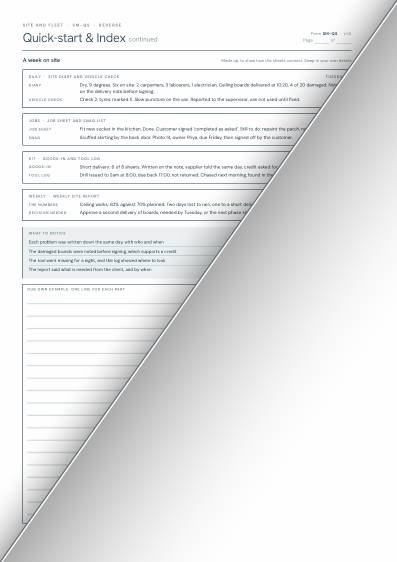
- Quick-start and index
- Guide: how to use it
- Guide: in practice and troubleshooting
Use it when
- Setting the pack up for a site or van
- A new supervisor takes over
- The records have slipped and you need a reset
TAB 2Daily3 items
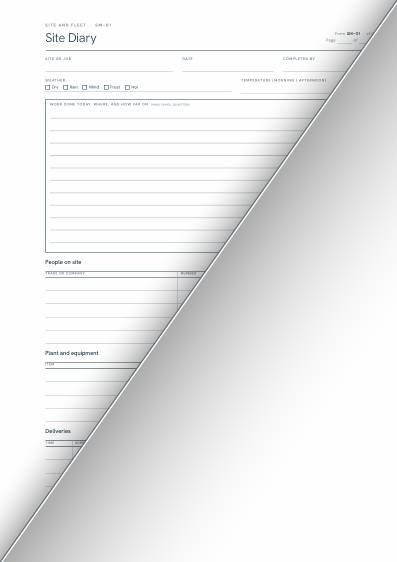
The daily records: what happened, who was on site, whether the vehicles and plant are safe to use, and who's been briefed.
Behind this tab
- Site DiaryRefill
- Vehicle & Plant Daily CheckRefill
- Site Induction Record
Use it when
- Every day, before work starts and at the end
- A new person or company arrives on site
- Something happens that you may need to prove later
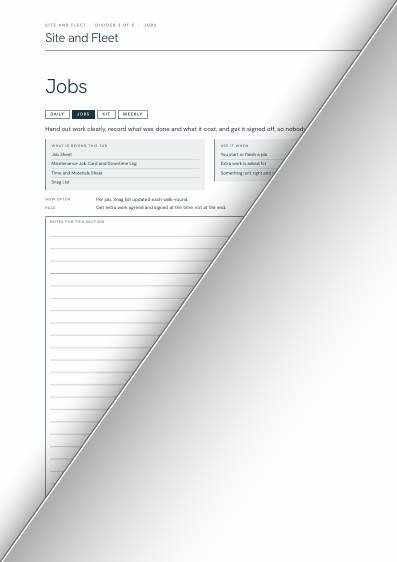
TAB 3Jobs4 items
Hand out work clearly, record what was done and what it cost, and get it signed off, so nobody argues about it later.
Behind this tab
- Job SheetRefill
- Maintenance Job Card & Downtime Log
- Time & Materials SheetRefill
- Snag List
Use it when
- You start or finish a job
- Extra work is asked for
- Something isn't right and needs fixing before sign-off
TAB 4Kit2 items
Know what's arrived, what's out, and what's gone missing: deliveries checked at the door, and tools and keys signed out and back in.
Behind this tab
- Goods-in & Stock Check
- Tool & Key Issue Log
Use it when
- A delivery arrives
- A tool or key leaves the store
- A count is due, or something is missing
TAB 5Weekly1 item
Look back at the week, say what's behind and why, and ask for what you need. It's the one page your client or manager will actually read.
Behind this tab
- Weekly Site ReportRefill
Use it when
- End of each week
- Someone asks how the job is going
- You need to explain a delay
See inside
The real pages. Select one to enlarge it.
These are the A4 working designs, shown as the upper-left half of each page. You see the full sheet in the pack. The paper, punching and final layout are confirmed before the first print run.
Questions people ask
The answers, whether or not you buy the pack.
What should go in a site diary?
The date and weather, who was on site, what work was done, deliveries, plant and equipment used, any instructions you were given (spoken ones too), and any accidents, near misses or problems. Keep it short, and write it during the day, not from memory at the end of the week.
Why keep a site diary?
It's often the first record of what happened if there's a disagreement about extra work, delays or a delivery. A note written on the day is more reliable than anyone's memory a month later.
How do I record extra work?
Write down what was asked, who asked for it, and the date, and get it signed on the day. The Job Sheet has a place for this. It stops 'I thought that was included' turning into an argument.
What is a snag list?
A list of the small defects to put right before a job is signed off as finished. Each one gets where it is, who's fixing it and a date, and gets ticked off when it's done.
How should I check a delivery?
Check it at the door, before you sign. Count it, look for damage, and compare it with the order. If something's short or damaged, write that on the delivery note before you sign, and take a photo.
How do I keep track of tools and keys?
Sign them out and back in on one page: what, who, when it went out, when it came back. Check the page at the end of the day, so something that's missing is noticed the same day, not the next month.
About the packs
Before you join the list.
Is this A4 or A5?
Both. The packs are made for A4 four-ring binders and A5 six-ring binders, pre-punched and double-sided. The pages shown here are the A4 designs. Tell us on the waitlist which size you want; your answers help decide which size is printed first.
What paper is it printed on?
We're choosing the paper and checking the punching with a printer. The paper and hole positions will be confirmed before the first run.
How do you decide which packs get printed first?
By how many people ask for them. When you join the waitlist you can choose as many packs as you like, and tell us which one you would want first.
Can I buy the refills separately?
Yes, that's the plan. Each pack is a starter set with a few of every sheet. The ones people use up are marked as refills, and will be sold separately, so you only reorder what you use.
Where do you deliver?
The United Kingdom to start with.
Is this legal or compliance advice?
No. These are blank record sheets designed by Clare Langley. They are independent and are not published, endorsed or approved by any regulator, standards body or certification body. Using them does not make an organisation compliant with any law or standard. You decide what to record, how long to keep it and how to store it securely. Check current guidance for your own setting.