

Packs / Service Improvement and Experience Pack
Service Improvement and Experience Pack
Notice what keeps going wrong, find the cause, change one thing, and check it worked.
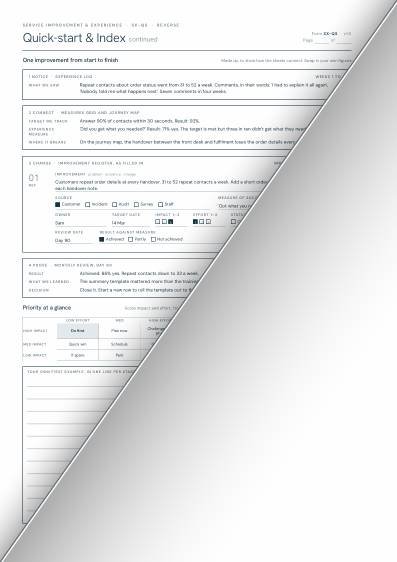
A complete way of working in four steps: notice, connect, change and prove. It includes an experience log, a quick survey tally, a grid that puts your targets next to what customers actually experienced, a map of journeys and handovers, an improvement register, a one-page change plan, and a monthly and quarterly review.
- 7 working sheet designs
- 5 tabbed dividers
- Worked example
- Plain-English guide
- A4 and A5 binders
Who it's for
Written for the person who runs the day.
- Service desk, operations and customer experience leaders
- Teams who want improvements to last, not just start
- Managers who need to show what changed, and why
What it helps you do.
- Customers' own words sit next to the numbers
- Every improvement has an owner, a date and a measure
- A monthly review shows what worked and decides what happens next
What is inside
5 tabs, each with its own sheets.
TAB 1Start here2 items
How the pack works, who does what, and when to reorder. Read it once, and come back to it when someone new takes over the register.
Behind this tab
- Quick-start and index
- How-to guide
Use it when
- Setting up the pack for the first time
- A new register owner takes over
- The monthly review is slipping and you need a reset
TAB 2Notice2 items
See what keeps coming up: how service feels week by week, in numbers and in customers' own words. This is where most improvements start.
Behind this tab
- Customer Experience Monthly LogRefill
- Pulse Survey TallyRefill
Use it when
- Every week, one line in the log
- A pattern keeps appearing in comments or contacts
- You need evidence before you ask for a change
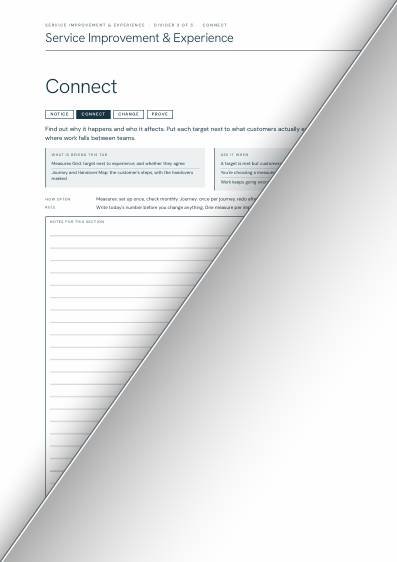
TAB 3Connect2 items
Find out why it happens and who it affects. Put each target next to what customers actually experienced, and find where work falls between teams.
Behind this tab
- Target vs Experience Grid
- Journey & Handover Map
Use it when
- A target is met but customers are still unhappy
- You're choosing a measure for a new improvement
- Work keeps going wrong between teams
TAB 4Change2 items
Pick one change, one owner and one date, and be honest about the effort. Small changes go on the register. Bigger ones get a one-page plan.
Behind this tab
- Improvement RegisterRefill
- Service Change One-Page Plan
Use it when
- You decide to change something
- An improvement involves several teams or will take months
- It will change something customers or staff notice
TAB 5Prove1 item
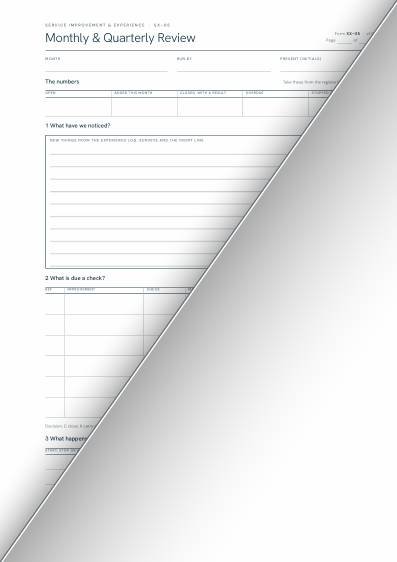
Check the numbers moved. Review each month, decide what happens next, and report each quarter, so people can see the improvement and don't just have to take your word for it.
Behind this tab
- Monthly & Quarterly ReviewRefill
Use it when
- The monthly review is due
- An item reaches 30, 60 or 90 days
- It's time to report to the sponsor
See inside
The real pages. Select one to enlarge it.
These are the A4 working designs, shown as the upper-left half of each page. You see the full sheet in the pack. The paper, punching and final layout are confirmed before the first print run.
Questions people ask
The answers, whether or not you buy the pack.
What is a continual improvement register?
A simple list of the improvements you've decided to make: what it is, why, who owns it, the date, and how you'll know it worked. It can be a page in a binder or a spreadsheet. What matters is that someone looks at it every month.
How do I start improving customer experience without a big programme?
Start small. One register, one owner, one monthly review, and three to five improvements. Pick the thing customers keep complaining about, change one thing, and check whether it worked.
Why can we hit every target and customers still be unhappy?
Targets measure what the team does, not what the customer feels. A response time can be met while the customer still has to explain everything twice. Put the target next to what customers actually said, and the gap shows up.
How do I know if an improvement worked?
Decide the measure before you start, write down where you began, and check again after a set time, such as 30, 60 and 90 days. If the number hasn't moved, say so, and decide what to try next.
What should I log about customer experience?
Customers' own words, repeat contacts, how long it took, and what they had to do for themselves. Their words matter as much as the numbers, because they tell you why.
About the packs
Before you join the list.
Is this A4 or A5?
Both. The packs are made for A4 four-ring binders and A5 six-ring binders, pre-punched and double-sided. The pages shown here are the A4 designs. Tell us on the waitlist which size you want; your answers help decide which size is printed first.
What paper is it printed on?
We're choosing the paper and checking the punching with a printer. The paper and hole positions will be confirmed before the first run.
How do you decide which packs get printed first?
By how many people ask for them. When you join the waitlist you can choose as many packs as you like, and tell us which one you would want first.
Can I buy the refills separately?
Yes, that's the plan. Each pack is a starter set with a few of every sheet. The ones people use up are marked as refills, and will be sold separately, so you only reorder what you use.
Where do you deliver?
The United Kingdom to start with.
Is this legal or compliance advice?
No. These are blank record sheets designed by Clare Langley. They are independent and are not published, endorsed or approved by any regulator, standards body or certification body. Using them does not make an organisation compliant with any law or standard. You decide what to record, how long to keep it and how to store it securely. Check current guidance for your own setting.