

Packs / People Records Pack
People Records Pack
What a manager needs to look after their people: regular conversations, a good start, room to grow, and a way through the hard conversations.
One-to-ones, recognition, starter inductions, development plans, training, skills cover, a yearly review, and a sheet for getting ready for a difficult conversation. Every sheet reminds you to keep it confidential, and asks for facts, not guesses.
These pages record things about people, so keep them secure and share them with the person they're about. They're working records, not formal procedures. For anything serious, follow your own procedure or take advice.
- 8 working sheet designs
- 5 tabbed dividers
- Worked example
- Plain-English guide
- A4 and A5 binders
Who it's for
Written for the person who runs the day.
- Managers and team leaders
- Owners with staff
- Supervisors who've just started managing people
What it helps you do.
- Regular conversations that are about them, with actions written down
- Good work gets noticed and written down when it happens
- Hard conversations are planned, not improvised
What is inside
5 tabs, each with its own sheets.
TAB 1Start here3 items
How the pack works, who can see what, and when to reorder. These pages are about people, so read the guide first.
Behind this tab
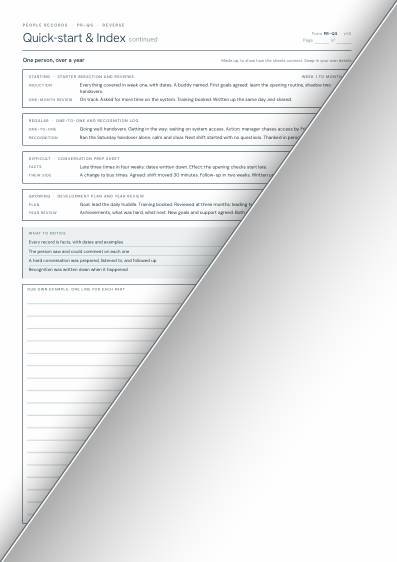
- Quick-start and index
- Guide: how to use it
- Guide: in practice and troubleshooting
Use it when
- Setting the pack up for a team
- A new manager takes over
- You're about to have a conversation you're unsure about
TAB 2Regular2 items
The small, regular things that make the biggest difference: a conversation that's about them, and a thank you that says what they did.
Behind this tab
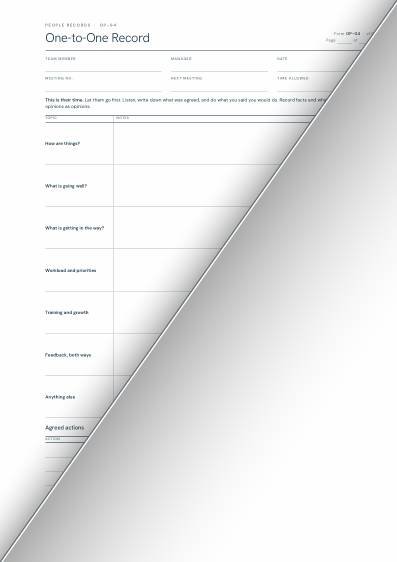
- One-to-One RecordRefill
- Recognition & Feedback Log
Use it when
- Your regular one-to-one is due
- You see good work
- You have feedback to give, good or difficult
TAB 3Starting1 item
The first weeks decide whether people stay. Give everyone a clear start, then check in.
Behind this tab
- Starter Induction & Reviews
Use it when
- Someone is about to join
- It's their first week, month or three months
- You want to check an induction is complete
TAB 4Growing4 items
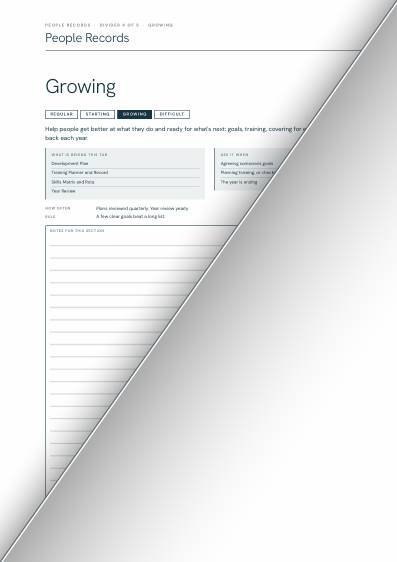
Help people get better at what they do and ready for what's next: goals, training, covering for each other, and a look back each year.
Behind this tab
- Development Plan
- Training Planner & Record
- Skills Matrix & Rota
- Year Review
Use it when
- Agreeing someone's goals
- Planning training, or checking who can cover what
- The year is ending
TAB 5Difficult1 item
Get ready for the hard conversations: the facts first, their side, the support available, and what you want to happen.
Behind this tab
- Conversation Prep SheetRefill
Use it when
- You need to raise a concern about work
- Something keeps happening and hasn't been addressed
- You aren't sure how to start
See inside
The real pages. Select one to enlarge it.
These are the A4 working designs, shown as the upper-left half of each page. You see the full sheet in the pack. The paper, punching and final layout are confirmed before the first print run.
Questions people ask
The answers, whether or not you buy the pack.
How often should you have one-to-ones?
Most advice says every one to four weeks, depending on the size of your team and how new people are. Weekly or fortnightly suits new starters. Monthly is a common minimum for people who know the job. What matters most is that it actually happens, and isn't the first thing you cancel.
What should a one-to-one cover?
Their agenda first: how it's going, what's in the way, what they need. Then your feedback, their goals and any training, and clear actions with dates, for both of you. Keep urgent problems out of it and deal with them when they come up.
How do you prepare for a difficult conversation with an employee?
Get the facts and dates first. Decide what you want to happen. Think about their side and what support you can offer. Plan clear words, then write down what was agreed afterwards. The Conversation Prep Sheet follows those steps.
Should I keep notes of conversations with staff?
Yes: the date, who was there, what was said and what was agreed, stored securely. The person can ask to see them. For anything formal, such as capability, discipline or a grievance, follow your own procedure and look at Acas for guidance.
What should be in a new starter induction?
A clear first day and first week, who to ask, what's expected of them, a named buddy, and check-ins at the end of the first week and the first month. The first few weeks decide a lot about whether people stay.
How do you give good feedback?
Say what you saw, what difference it made, and what you'd like next time. Be specific, and do it soon after. 'Good job' doesn't help. 'You calmed that customer down and the queue kept moving' does.
About the packs
Before you join the list.
Is this A4 or A5?
Both. The packs are made for A4 four-ring binders and A5 six-ring binders, pre-punched and double-sided. The pages shown here are the A4 designs. Tell us on the waitlist which size you want; your answers help decide which size is printed first.
What paper is it printed on?
We're choosing the paper and checking the punching with a printer. The paper and hole positions will be confirmed before the first run.
How do you decide which packs get printed first?
By how many people ask for them. When you join the waitlist you can choose as many packs as you like, and tell us which one you would want first.
Can I buy the refills separately?
Yes, that's the plan. Each pack is a starter set with a few of every sheet. The ones people use up are marked as refills, and will be sold separately, so you only reorder what you use.
Where do you deliver?
The United Kingdom to start with.
Is this legal or compliance advice?
No. These are blank record sheets designed by Clare Langley. They are independent and are not published, endorsed or approved by any regulator, standards body or certification body. Using them does not make an organisation compliant with any law or standard. You decide what to record, how long to keep it and how to store it securely. Check current guidance for your own setting.